
By Kehley Coleman
Helix
At 8 p.m. on a Friday night in the cleanroom, no one can hear me scream, not even me. That’s partially because of the loud background hum of the tools I’m surrounded by, the high-powered air vents that prevent dust from piling up, the surgical mask over my mouth and the hairnet and the hood pulled over my ears. Also, there’s no one else down here in this basement research facility on the Northwestern University campus anyway. It’s 8 p.m. on a Friday night. I would’ve loved to have left two hours ago myself.
Unfortunately, I’ve just pulled my sample out of the vacuum-sealed chamber that chemically etches excess protective insulating material away from the tops of the electrical devices I’m fabricating, and I can tell by looking at it under the microscope that the etch still isn’t complete. If I stop now, with that insulation still covering the metal caps of my device pillars, I won’t be able to make electrical contact to those pillars later. That means I won’t be able to measure the flow of electrons that will — hopefully — be generated within them when they’re illuminated by infrared light. Which in turn means they won’t really be photodetector devices at all, and my lab group will be no closer to our goal of developing the sensitive, energy-efficient detectors which we hope will enable next-generation technologies from self-driving cars to retinal scanners to fiber-optic communications.
So, to prevent that outcome, I’m going to have to stick around to load the devices back in for another etch cycle.
I sigh deeply and lift the chamber lid again. Once more unto the breach, dear friends, once more.
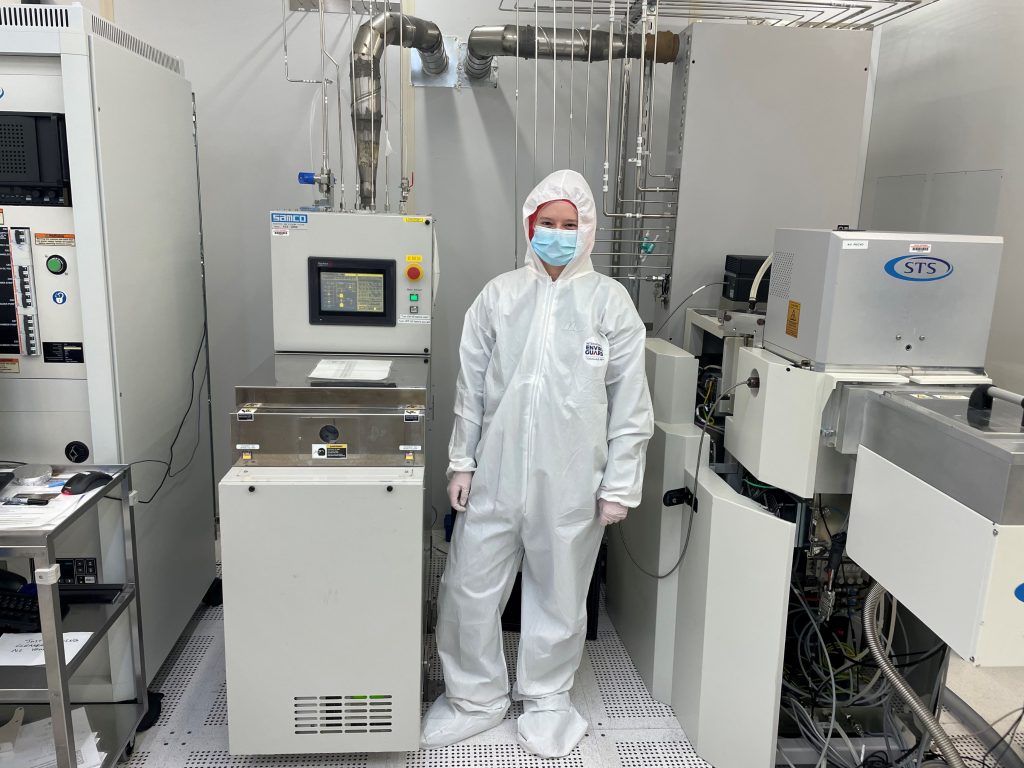
We call it the cleanroom because it’s clean. Walls, floor, overhead lighting are a harsh, sterile white. To enter, you have to wear a sort of hooded-and-footed plastic bag over your clothes, which zips up to cover all the parts of you that aren’t already covered by your gloves and mask. I made the mistake once of sending a picture of myself so attired to my family group chat and my eighth-grade sister seems to have gotten from it the idea that I work with biohazards. Every time I call home she asks if anything’s escaped from the lab. I’ve tried and failed at explaining to her that none of my samples are alive, or even particularly dangerous — we wear the bag-suit to protect them from us, not the other way around. Any speck of dust or oily trace left by contact with bare skin could contaminate or destroy the tiny device structures we work so hard to create on their surfaces.
That’s not to say the cleanroom is hazard-free. Many of the tools in there could kill you, at least if you worked hard enough to find a way around all the overrides that stop toxic gases and high voltages from escaping their sealed chambers. Some of what’s in there could kill you very easily. Over in the acid hood, for example, we keep jugs of the hydrofluoric acid which we use to wet-etch electrically insulating silicon oxide off the surface of our electrically conductive material so that we can make devices out of it—and which we pray won’t spill on us and also remove the calcium from our bones. The problem is, the acid’s dilute enough that it won’t burn your skin, so you might not even notice a problem until hours later, when you need a limb amputation to save your life. And that’s if you’re lucky. I made the mistake once of complaining to my family group chat about how nervous I felt immediately before I had to go and mess with the stuff and my father replied with a YouTube clip from Breaking Bad where Jesse, somewhat scientifically inaccurately, dissolves a body — and a bathtub, and a ceiling — with it. I should probably stop texting my family about work.
The acid hood is dangerous enough that not even users like me who’ve been granted the dubious honor of 24-hour access to the rest of the facility are allowed to use it alone at night. Fortunately, I don’t need to go in there now. I’m just using plasma (that mysterious fourth state of matter, higher-energy even than gas) to chemically and physically attack the surface of my sample. Not so dangerous, but tedious, and easy to mess up. You can’t watch your sample while it’s sealed in the etch chamber. For a process in which it’s crucial to remove a precise amount of material, like the one I’m doing currently — just enough to expose those metal contacts on the very tops of my device pillars; not enough to remove the protective material from their sides — the best way to avoid overshooting is to etch in very small steps. Put the sample in the chamber, send in the plasma for 15 seconds, take it back out, look at it again. The problem is, every time you put the sample in, you have to wait for all the air in the chamber to be pumped out before the plasma can start, and every time you take the sample out, you have to wait for the chamber to come back up to atmospheric pressure before you can open it. It comes out to maybe 20 minutes for every 15-second etch cycle.
You see now why I’m stuck here so late.
It’s incredibly frustrating, moving this slowly. Particularly when you know you could save hours by being a little less cautious, etching for a full minute at a time, instead of four 15-second stages. But that’s not how scientific progress is made, in my experience. Good science is incremental. You can try to rush to the exciting discovery, that “a-ha” moment when you first shine a light on your finished photodetectors and see the electrical current that rushes through them in response, and you’ll often want to. But when you move too quickly, when you don’t take the time to carefully look at your sample in between process steps, it’s easy to miss something and ruin the whole sample entirely. I’ve been there. It’s not a good feeling, and I don’t want to be there again.
I will be, of course. That’s also how scientific progress is made — with a lot of failures along the way, no matter how careful you try to be.
But this particular step in the process, I’m determined not to mess up. I check my sample again — it’s almost done, I think. I can see rainbow fringes on the metal top contacts of my devices, meaning the layer of protective insulation I’m trying to remove is very thin now. This next cycle should be the last.
I know a lot of people who hate going in the cleanroom, and I don’t blame them. It’s uncomfortable, being gowned and masked up under bright lights next to tools and vents so loud you can’t hear yourself think. You’re on your feet for long stretches, sweating bullets while pouring glass-eating acid from the storage jugs into the special plastic beakers you can dip your samples into. People burn out on it—they barter with their advisors to avoid taking on projects that require cleanroom time, or they just drop out of grad school. I also know some—albeit fewer—people who genuinely seem to love it.
My own feelings are mixed. I don’t mind gowning up and going in. I don’t mind babysitting tools to make sure nothing goes wrong with the process of depositing metal onto or etching insulation off of my samples. It’s boring, once the novelty of interacting with the machines wears off, but we’re allowed to bring in our computers. I can always find something to do while I wait. Much harder to take than the boredom, though, is the stress. Our materials are expensive, and so are hours on the tools. Every sample represents a lot of both, and the possibility of complete and total failure — meaning nothing to show for all that money and all that time — is there in nearly every step of the processing I do.
But there’s nothing like the satisfaction I feel when I get to take the mask off and walk out of the cleanroom knowing I got it right today.
When I remove my sample from the etch chamber this time, I’m confident it’s finally done. I stow it safely in a drawer and start powering off the etcher. While I wait for its shut-down cycle to finish, I pull up the cleanroom website to take a look at the tool schedules for next week, and start making reservations on the equipment I’ll need to use to continue my processing. I start thinking, too, about setting up for the measurements I’ll have to make on my devices once I finish fabricating them, to see if the changes we’ve made to our material design really translate to faster, better detectors. But that’s all assuming I complete the rest of the processing steps successfully, and I don’t want to get too far ahead of myself, yet. We’ll see how next week goes.
For now, though, I’m done with work for a couple of days. I emerge from the basement, into the cool night, and take — finally — a breath of fresh air.
Kehley Coleman is a Ph.D. student in electrical engineering at Northwestern University.